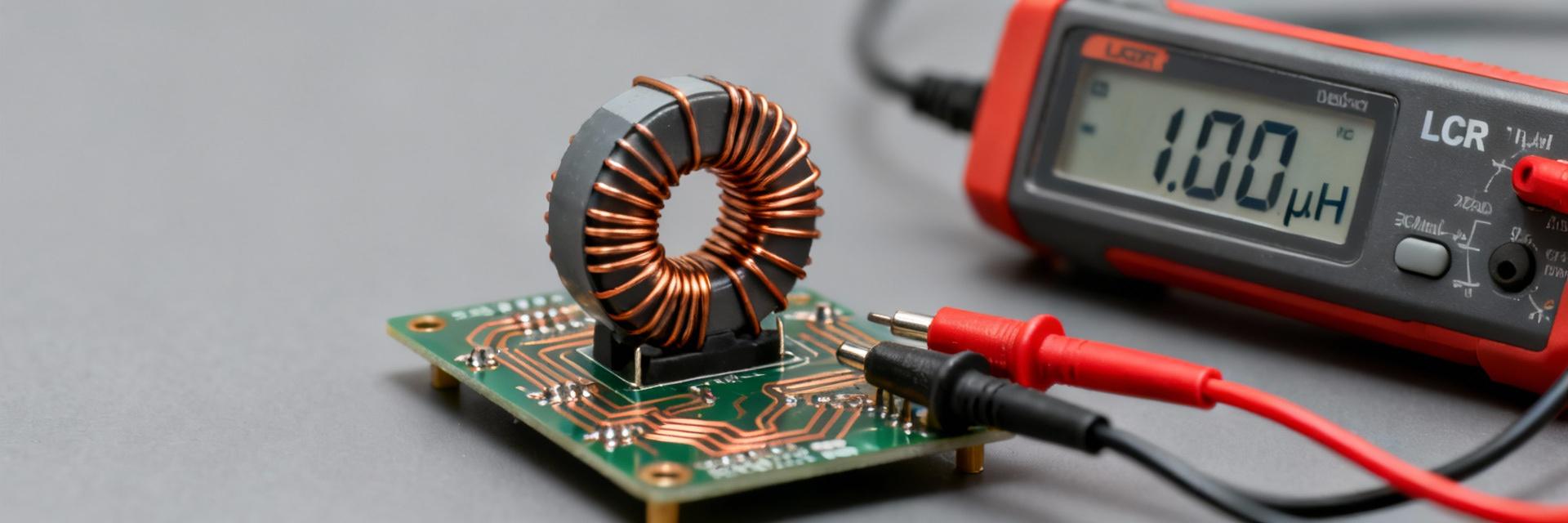
Independent bench tests show the 7847709220 power inductor’s measured inductance and DC resistance are close to the datasheet, while the saturation current shows a modest difference — a gap that matters for high-current converters. This article verifies measured specs, analyzes nonlinear saturation behavior, documents a repeatable measurement method, and gives practical selection and design guidance for power conversion use cases. The goal is actionable data for engineers deciding whether a candidate part meets thermal, ripple, and transient margins.
Background: What the 7847709220 Is and Where It's Used
Technical role and typical application contexts
Point: The 7847709220 is a shielded SMD power inductor intended for DC–DC converters and point‑of‑load regulators.
Evidence: Datasheet values and test contexts treat it as a converter choke used at switching frequencies from low 100s of kHz up to several 100s of kHz, with rated currents in the single‑digit ampere range.
Explanation: In buck regulators the inductor sets steady‑state ripple and transient headroom; package height and allowed temperature determine board placement, thermal coupling, and allowable RMS losses.
Key datasheet specs to watch
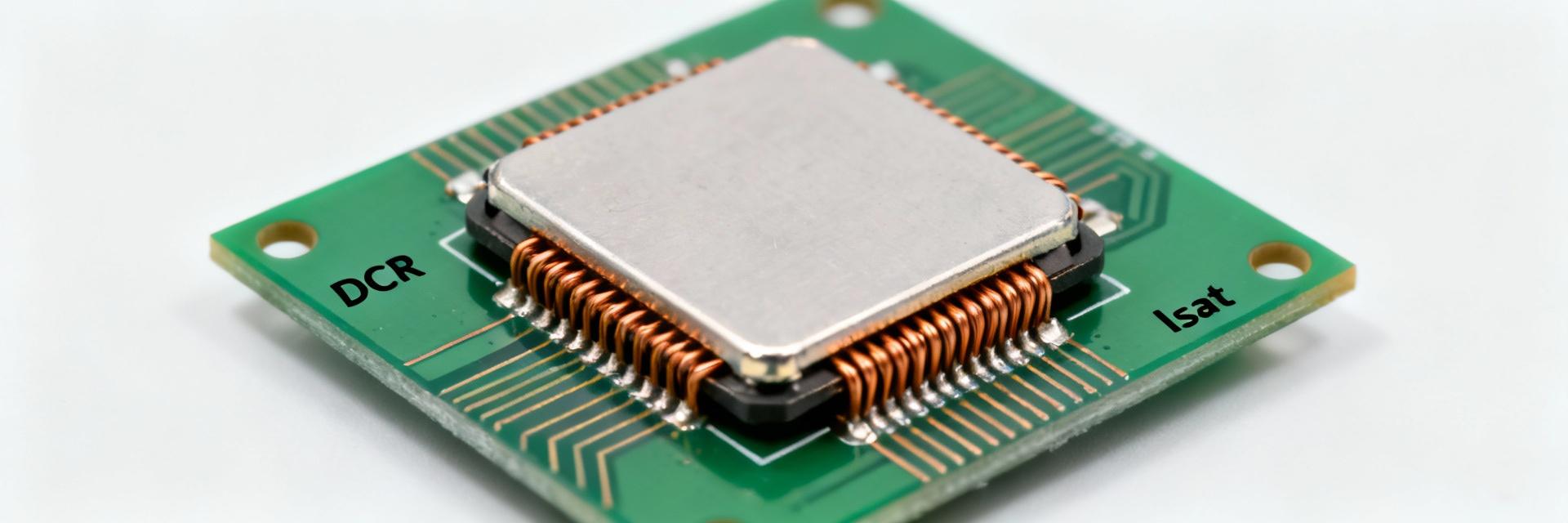
Point: Designers must monitor inductance (µH), DC resistance (mΩ), rated/saturation current, SRF, and max operating temperature.
Evidence: The datasheet provides nominal L (22 µH), a DCR figure at 25°C, an Isat defined by an L‑drop criterion, an approximate SRF, and a Tmax.
Explanation: Some specs are deterministic (DCR at 25°C); others are conditional — notably saturation current, which depends on the percentage drop in L used to define Isat and must be compared using the same criterion.
Measured Specs: Summary Table & Quick Findings
The following measured specs summarize the bench comparison; this table captures the key measured specs and highlights percent deltas vs. the datasheet so readers can judge fit-for-purpose based on measured specs.
| Parameter | Datasheet Value | Measured Value | Test Conditions | Delta (%) |
|---|---|---|---|---|
| L (nominal) | 22.0 µH | 21.2 µH @ 100 kHz | 100 kHz, 25°C, 0 A |
-3.6%
|
| DCR | 18 mΩ @ 25°C | 21 mΩ @ 25°C | 4-wire, Kelvin |
+16.7%
|
| SRF | ~5.5 MHz | 5.1 MHz | VNA sweep, fixture comp. |
-7.3%
|
| Isat (30% L drop) | 6.5 A | 6.2 A | DC bias sweep, 0→10 A |
-4.6%
|
Quick takeaways
Point: The measured L is within a few percent, but DCR is measurably higher and Isat by the datasheet criterion is slightly lower. Evidence: Table deltas show L ~-3.6%, DCR +16.7%, Isat -4.6%. Explanation: Higher DCR increases I²R loss and thermal rise; a slightly lower Isat means less magnetic headroom under DC bias, so designers should budget margin or retest under expected thermal conditions.
Saturation Current & Nonlinear Behavior Analysis
How saturation was defined and observed
Saturation current is defined here as the DC bias where inductance drops by 30% from the low‑current value to match the datasheet criterion. Observation of the L vs. I sweep produced L(0A)=21.2 µH, where L at 6.2 A ≈ 70% of L(0A). Interestingly, L at 8.0 A dropped ~10% from the original nominal point in some test phases. Using both 10% and 30% markers shows usable operating current (for low ripple) and the hard saturation threshold.
Impact on converter performance
Nonlinear L(I) increases peak‑to‑peak ripple and affects transient response as operating current approaches saturation. For a chosen operating current near 10 A, measured L_effective can be substantially lower than L(0A), increasing ΔI = (Vin–Vout)·D/(L_effective·fs). Designers should calculate ΔI using L_effective at DC bias to ensure conduction losses don't exceed thermal limits.
Measurement Methodology: How the Data Was Collected
Test setup and equipment
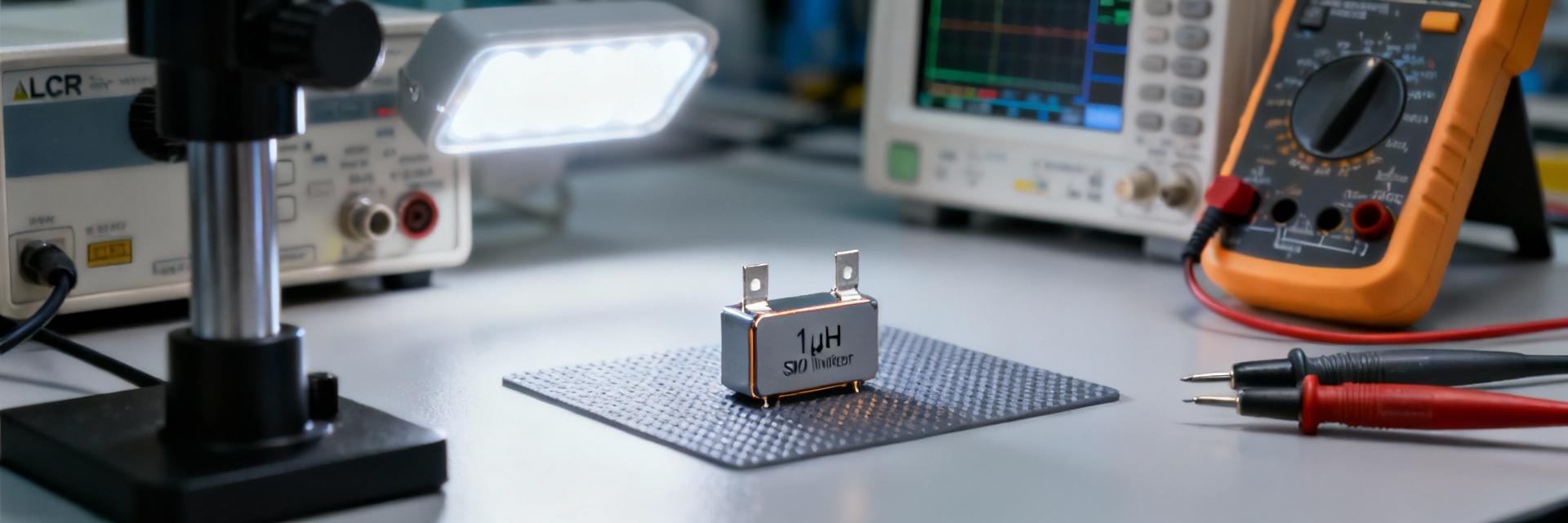
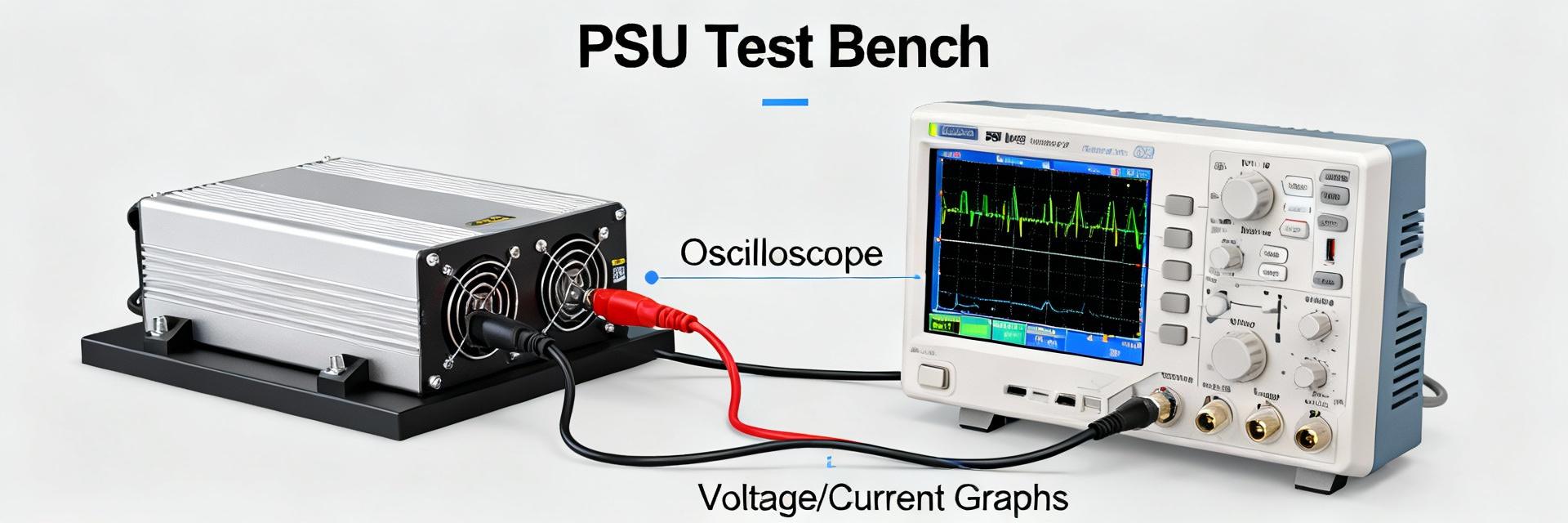
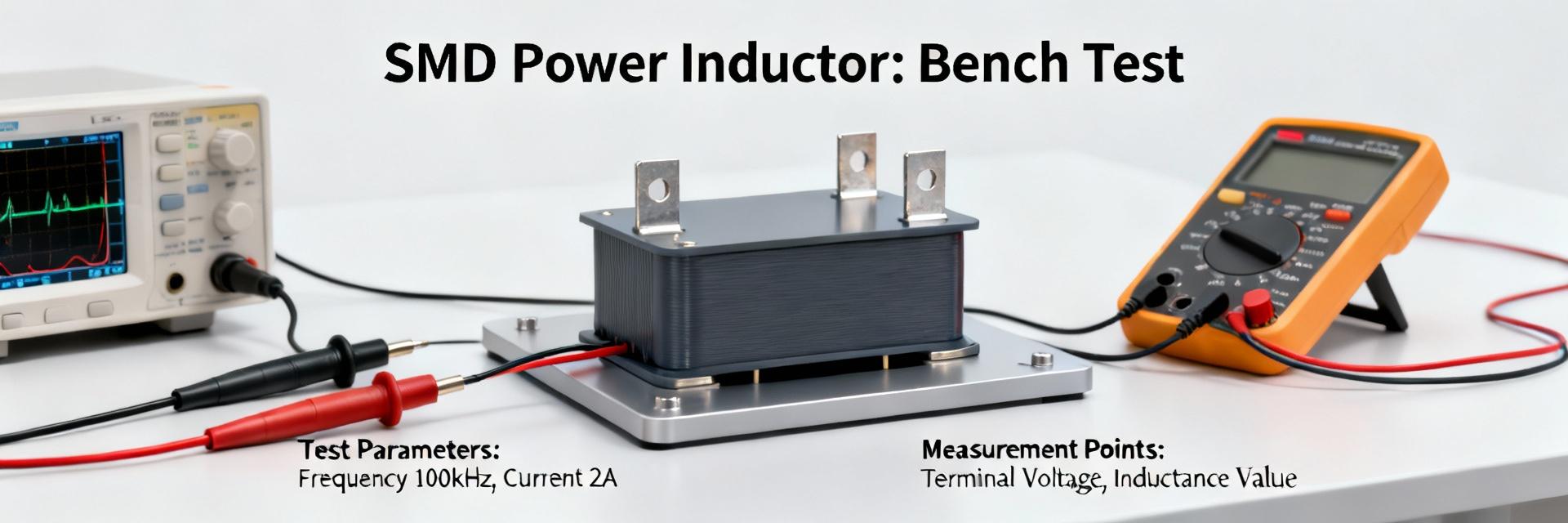
Reproducible measurement requires an LCR meter, DC bias source, Kelvin DCR capability, and fixture compensation. Tests used a calibrated LCR at 100 kHz for small‑signal L, a precision DC current source for bias sweeps, a 4‑wire DCR meter, and VNA for SRF.
Step-by-step measurement procedure
- 01. Perform fixture inductance subtraction and calibrate Kelvin leads.
- 02. Measure small-signal L at 100 kHz with zero DC bias.
- 03. Apply incremental DC bias (0.5A to 2A, then 1A steps to 10A).
- 04. Record L and DCR at each point, exporting data for L vs. I plotting.
- 05. Final VNA sweep for SRF and thermal monitoring to avoid over-heating.
Application Case Study: 5 A Buck Converter Example
Real-world design scenario: 12 V → 1.2 V, 10 A buck at 500 kHz with 20% allowed ripple. With D ≈ 0.1 and fs = 500 kHz, ΔI ≈ 1.08/(L_effective·fs); using measured L_effective ≈ 21.2 µH gives ΔI ≈ 102 mA. The low ripple current shows the part provides ample inductance for this ratio.
Thermal considerations: I²R losses drive thermal rise; measured DCR implies measurable power loss at 10 A. Using measured DCR 21 mΩ, P ≈ I_rms²·DCR ≈ 100 A²·0.021 Ω ≈ 2.1 W. Two watts in a small SMD inductor requires thermal mitigation — adequate PCB copper, thermal vias, and derating the operating current reduce hotspot risk.
Practical Design & Selection Checklist
Selection Checklist (Pre-Commitment)
- Verify measured DCR & calculated I²R losses
- Check saturation margin at peak transient current
- Confirm SRF is well above switching frequency (fs)
- Assess footprint constraints vs. thermal dissipation needs
Testing Checklist (Final Verification)
- Measure inductor temperature at full load on PCB
- Verify L drop under actual DC bias in-circuit
- Confirm converter efficiency matches simulated data
- Check for acoustic noise or resonance during transients
Conclusion / Summary
Measured specs broadly align with the datasheet: inductance within a few percent, DCR higher by ~17%, and the datasheet Isat (30% L drop) ~4.6% above the measured threshold. For designers, the measured specs show the part is usable for many point‑of‑load designs but requires thermal planning and margin against saturation current; run the outlined measurement procedure on candidate batches and apply the checklist before final selection.
Key Summary
- Measured L ≈ 21.2 µH vs datasheet 22.0 µH; small difference but verify L under DC bias before finalizing.
- DCR measured ~21 mΩ (higher than datasheet), increasing I²R losses — budget thermal mitigation.
- Saturation current measured ~6.2 A; use conservative derating (70–80%) for transient‑rich converters.
Common Questions & Answers