Key specifications explained (voltage, current, power, ripple, efficiency, hold-up)
Point: Clear definitions prevent misinterpretation of datasheet numbers. Evidence: Voltage tolerance means allowed steady-state variation; continuous current is what the device can supply indefinitely, while peak/short-duration currents are specified separately. Explanation: Read datasheets for continuous ratings, thermal derating curves, ripple at specified test points, and hold-up time under stated load. Common pitfalls include treating peak current as continuous capability and ignoring ambient-temperature derating.
Topologies at a glance and when to pick each (linear, switching, buck, boost, isolated)
Point: Topology drives efficiency, EMI, size, and cost trade-offs. Evidence: Linear regulators give low noise but poor efficiency at large Vin–Vout drops; switching converters (buck/boost) yield higher efficiency but require EMI mitigation and filtering. Explanation: Choose linear for ultra-low-noise analog rails, buck for step-down efficiency in compact designs, boost for higher output from lower inputs, and isolated supplies when safety or ground separation is required.
Data-backed criteria: which test metrics matter most
Efficiency, thermal curves and lifetime — what to measure
Point: Efficiency affects heat dissipation and long-term reliability. Evidence: Measure efficiency at 10%, 50%, and 100% load across the expected ambient range; request vendor thermal derating curves and MTBF estimation methodology. Explanation: Use measured efficiency to size heatsinking and to estimate junction temperatures and component lifetime.
Transient response, ripple, and hold-up time
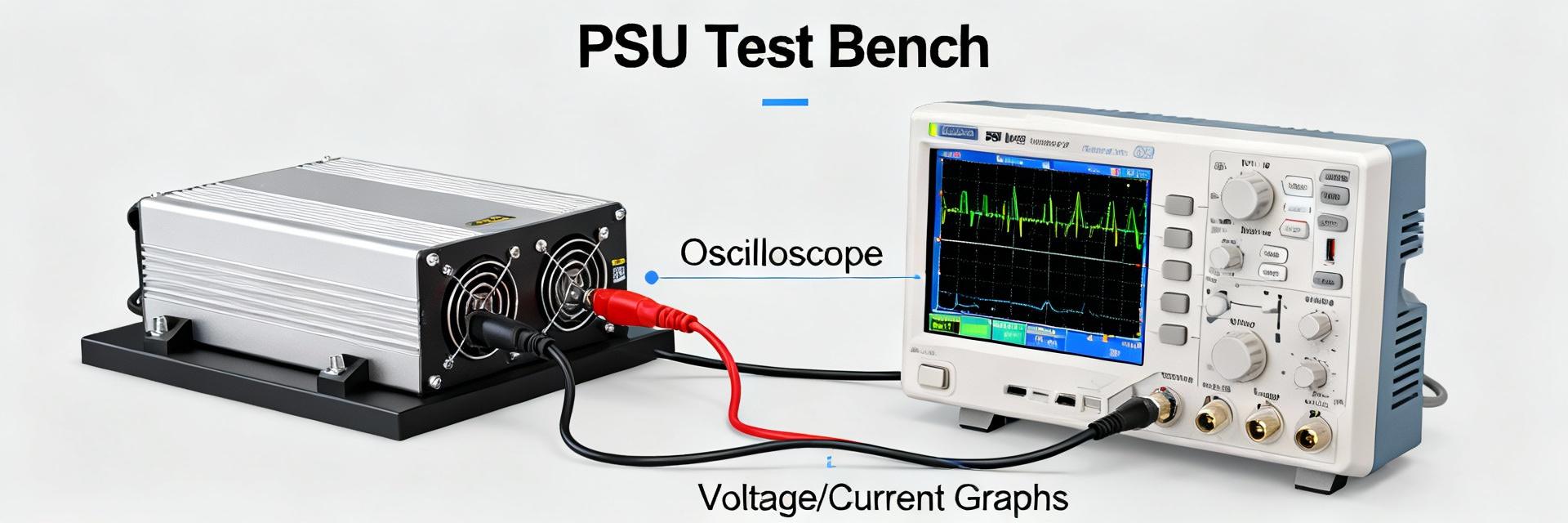
Point: Dynamic behavior determines whether downstream regulators remain in tolerance. Evidence: Test transient response with step loads (e.g., 10–90% in 100–500 µs) and measure overshoot. Explanation: For microcontrollers, short transients within a few percent are acceptable; power amplifiers need faster settling and lower ripple.
Step-by-step selection process (data-first workflow)
Define requirements & safety margins
Record input voltage range, inrush current, continuous and peak currents, and required derating (commonly 20–30%). Create a reusable RFQ attachment to ensure comparable vendor responses.
Bench validation & pass/fail criteria
Start with a smoke test, then efficiency and thermal run, followed by dynamic load steps. Define pass thresholds tied to application risk (e.g., ±5% voltage under transient).
Examples: applying the method to common use cases
Low-power IoT sensor node — selection walkthrough
Evidence: Capture sleep and wake currents, duty cycle, and battery capacity. Explanation: Narrow candidates by published no-load and standby figures, then validate sample behavior with a low-duty-cycle test rig that emulates real packet bursts.
Mid-range industrial controller — using 7847709471 as a datasheet example
Evidence: For 7847709471, extract continuous current, efficiency at key loads, and thermal derating curve. Compare against the controller's inrush currents. Explanation: If the part's specified continuous current exceeds demand with the chosen safety margin, it passes initial screening.
Procurement, verification & lifecycle
Procurement Checklist
- Full datasheet & efficiency charts
- Transient response plots
- Thermal derating graphs
- Safety certifications
- Lead times & reliability data
In-field monitoring
- Log voltage rails periodically
- Monitor ambient temperature
- Set alerts for threshold excursions
- Quarterly data review cadence
Summary
- Favor measured data over marketing: use efficiency and thermal curves to size cooling and estimate MTBF.
- Translate datasheet values into repeatable bench tests—efficiency at 10/50/100% loads and transient steps.
- Apply a checklist-driven selection with documented pass/fail criteria to avoid late-stage surprises.
Action: Run the outlined bench sequence on candidate parts and use the checklist to make procurement decisions; reduce field risk through execution.
Frequently Asked Questions
How much derating is safe for a power supply?
What test equipment is required to validate a power supply?
When is an isolated supply required?