Typical uses & performance expectations
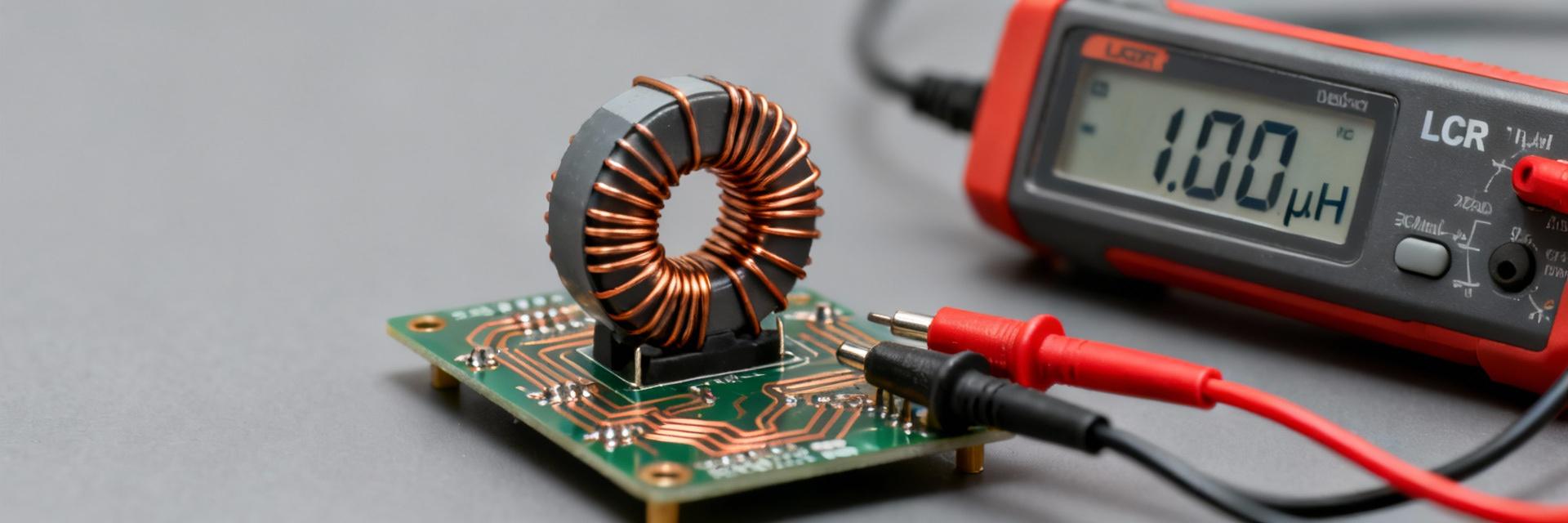
Point: The 1µH value balances energy storage and ripple for many synchronous buck, boost, and point-of-load converters. Evidence: At switching frequencies from ~200 kHz to several MHz, 1µH provides manageable ripple current while keeping peak currents and core losses moderate. Explanation: Designers select 1µH when target ripple, footprint, and transient response must be balanced without excessive DCR (Direct Current Resistance) or height.
Materials & construction that affect specs
Point: Core material and winding style dominate DCR, Isat, and SRF. Evidence: Ferrite cores give higher Isat and lower core loss at MHz frequencies, while powdered-iron/molded types handle DC bias with gentler inductance droop. Explanation: Shielding, packaging density, and termination style influence the thermal path and DCR; these choices affect both steady-state loss and transient saturation behavior.
Datasheet breakdown: what each spec really means
Key datasheet entries to verify
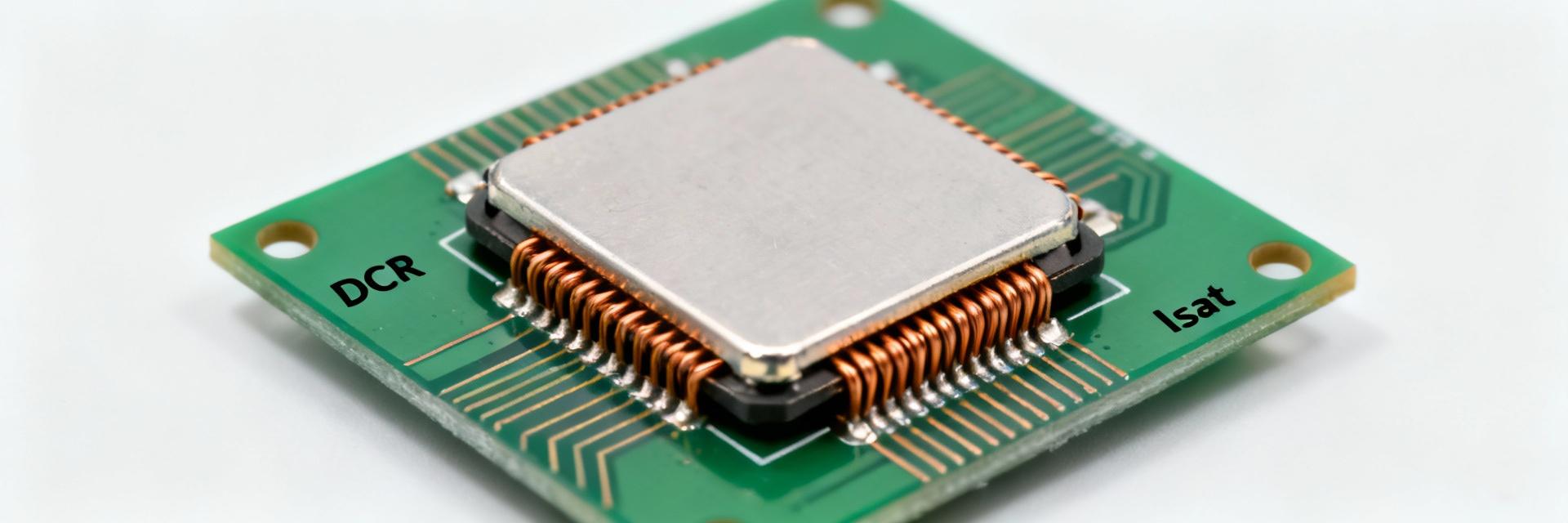
Critical datasheet fields include inductance (test frequency/tolerance), DCR, Isat, Irms, SRF (Self-Resonant Frequency), temperature rise, and dimensions. Manufacturers typically list L measured at a specific frequency (e.g., 100 kHz or 1 MHz) and specify Isat as an L-drop percentage.
Common datasheet caveats & reading tips
Datasheet wording can hide specific test conditions. Typical caveats include "L measured without DC bias" or "Isat defined at X% L drop" and unspecified ambient temperatures. Always confirm whether Irms is thermal-limited, whether Isat uses a 10% or 30% L drop, and whether DCR is measured at 25°C; assume worst-case scenarios when conditions are unspecified.
Isat: definition, measurement method and real-world impact
Inductance (L) Droop vs. DC Bias Current (Typical)
How Isat is defined & standardized test practice
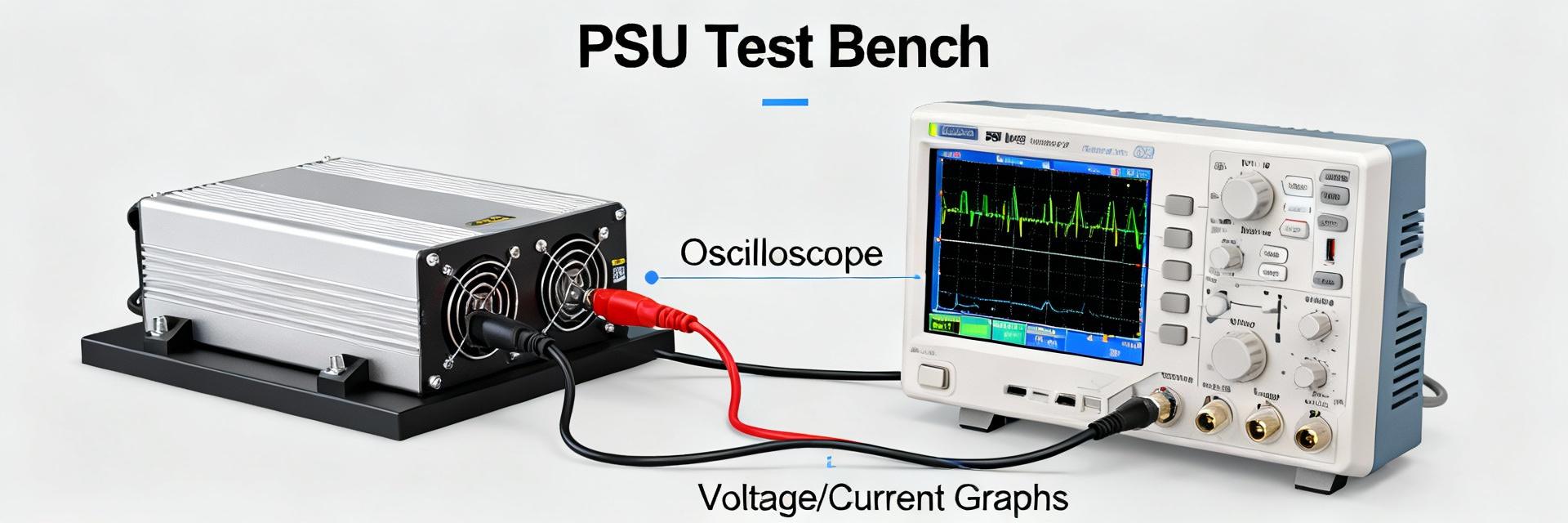
Isat is commonly defined as the DC current where inductance falls by a specified percentage (often 10–30%). Standard bench practice sweeps DC bias while measuring L at a set AC test frequency; the current at which L crosses the drop threshold is reported as Isat.
Isat vs Irms vs thermal limits
Isat governs short-term saturation and peak current handling; Irms controls continuous heating. A part may have high Isat but poor thermal dissipation, yielding low continuous Irms before unacceptable temperature rise occurs. Designers should set Isat margin for transients and use Irms/temperature-rise data for continuous derating.
Measured-specs report for a reference 1µH SMD power inductor
| Parameter | Datasheet Spec | Measured (Bench) | Condition |
|---|---|---|---|
| Inductance (L) | 1.0µH ±20% | 0.98µH | 100 kHz, 0.1V |
| DCR | 25 mΩ (Max) | 22.4 mΩ | @ 25°C Ambient |
| Isat (-30% L) | 4.5 A | 4.2 A | 100 kHz sweep |
| SRF | 80 MHz (Typ) | 76 MHz | Network Analyzer |
| Temp Rise | 40°C @ Irms | 42°C @ 3.8A | Still Air, 2-layer PCB |
Interpreting variability and tolerance
Expect sample-to-sample variation and frequency-dependent L. Typical tolerance bands (±10–20%) and manufacturing spread mean some measured parts will deviate from nominal. Inductance often decreases under DC bias and at high frequencies due to core and winding effects. Define acceptance criteria and flag parts with excessive DCR or unexpectedly low Isat.
Selection & application guidelines for designers
Converter Choice
Prioritize switching frequency, ripple current, and loss budget. For high-frequency converters, prioritize low core-loss ferrite parts with low DCR. For heavy DC bias, choose powdered or molded types with gentler L droop.
Thermal Layout
Large copper pours, thermal vias under the part, and close placement to the switch node reduce losses. Use conservative derating—typically 70–80% of rated Irms—and verify with thermal imaging.
Measurement protocol & validation checklist
- Calibrated Instruments: Ensure LCR meter, DC source, and micro-ohmmeter are within calibration dates.
- Baseline Measurement: Measure L vs frequency (100kHz, 1MHz) without bias to establish the baseline.
- Bias Sweep: Gradually increase DC current while monitoring L to pinpoint the exact Isat threshold.
- Thermal Soak: Apply rated Irms for at least 30 minutes before logging the final temperature rise.
- DCR Validation: Use a 4-wire Kelvin probe setup to eliminate lead resistance errors.
Summary & Takeaways
- Verify datasheet conditions: Confirm test frequency, L tolerance, and Isat definitions before finalizing the BOM.
- Measure both Isat and Irms: Isat indicates transient headroom; Irms determines continuous reliability.
- Standardize validation: Always record sample statistics (mean, sigma) to account for manufacturing spread.
Final action: run the validation checklist on candidate parts and document measured specs alongside the datasheet to avoid production surprises.
FAQ: Inductor Selection & Measurement
How is Isat reported in a datasheet and how should designers interpret it?
Datasheets commonly report Isat as the current where inductance falls by a specified percent (often 10–30%), measured at a stated AC test frequency and ambient. Designers should note the L-drop percentage and test frequency; use Isat for transient margin but verify Irms for continuous heating limits before relying on the part.
What measurement instruments and settings yield repeatable L and Isat data?
Use a calibrated LCR meter set to the datasheet test frequencies (e.g., 100 kHz, 1 MHz), a stable DC bias source for current sweeps, a precise micro-ohmmeter for DCR, and thermal imaging for temperature-rise tests. Document ambient temp, sample count, and sweep rate to ensure repeatability.
When is a measured deviation from the datasheet acceptable?
Minor variations within stated tolerances (e.g., ±10–20% L tolerance) are acceptable; larger deviations that impact ripple, saturation margin, or thermal loss are not. Accept parts only if measured values at intended operating bias and temperature meet your converter's electrical and thermal constraints.